
How User Patterns Shape AI Pricing Models

AI pricing models are shifting towards usage-based strategies, aligning costs with actual user behavior. Here's what you need to know:
- Key Metrics Driving Pricing:
- Usage Frequency: API calls, session duration
- Resource Consumption: Compute power, storage
- Task Complexity: Model size, processing time
- User Engagement: Feature usage, workflows
- Why It Matters:
- 45% of SaaS companies now use usage-based pricing, up from 34% in 2021.
- Companies adopting these models see revenue grow 38% faster.
- Privacy concerns are addressed with techniques like local data storage and encryption.
- Examples:
- NanoGPT offers pay-as-you-go pricing starting at $0.001 per use.
- IBM Watson AI Services improved customer retention by 28% with usage-based pricing.
This approach balances costs with delivered value, ensuring transparency and fairness while adapting to user needs. Read on to explore how these strategies are transforming AI pricing.
Rise of Usage-Based Billing in SaaS: Key Insights for Adopting Consumption Pricing
User Behavior Impact on AI Pricing
The connection between user behavior and AI pricing models is growing more refined. Companies are now leveraging usage data to create pricing structures that better align with how customers interact with their services. For instance, 45% of SaaS companies now use usage-based pricing models, a notable increase from 34% in 2021[3]. These insights help pinpoint the key metrics that shape pricing strategies.
User Metrics That Drive Pricing
To build effective pricing models, companies focus on several user behavior metrics. These metrics help reveal patterns that influence the perceived value of a service:
| Metric Category | Key Measurements | Impact on Pricing |
|---|---|---|
| Usage Frequency | API calls, session duration | Sets baseline pricing tiers |
| Resource Consumption | Compute power, storage | Influences per-unit pricing |
| Task Complexity | Model size, processing time | Adjusts premium pricing levels |
| User Engagement | Feature usage, workflows | Shapes package options |
These metrics allow for dynamic pricing adjustments. For example, IBM Watson AI Services introduced a model based on API calls and resource consumption. This approach led to a 28% improvement in customer retention and a 15% revenue increase within just six months[10].
Turning Usage Data into Pricing Models
Converting raw usage data into actionable pricing models requires ongoing refinement. Companies that adopt usage-based pricing are seeing revenue grow 38% faster compared to those sticking with traditional pricing methods[3].
- Real-Time Analytics: Tools to monitor telemetry data enable dynamic pricing updates based on resource usage. Microsoft's Azure OpenAI Service, for instance, uses strict data handling protocols while continuously optimizing its pricing structure[4].
- Value-Based Segmentation: By analyzing how different user groups interact with services, companies can create tailored pricing tiers. This strategy resonates strongly with customers - 61% say they prefer pay-as-you-go pricing over traditional subscription models for AI services[7].
To ensure user trust while collecting and analyzing usage data, businesses implement safeguards like data anonymization, local processing, encryption, and clear policies. These measures allow pricing models to evolve without compromising privacy or regulatory compliance.
Pricing Model Examples
Let's dive into how pricing models in the AI industry are shaped by user behavior metrics. Below are some examples that show how these insights are turned into practical billing strategies.
The AI sector offers a range of usage-based pricing models, each tailored to meet unique user needs. Platforms like NanoGPT provide a clear example of these approaches.
NanoGPT's Pay-As-You-Go Model
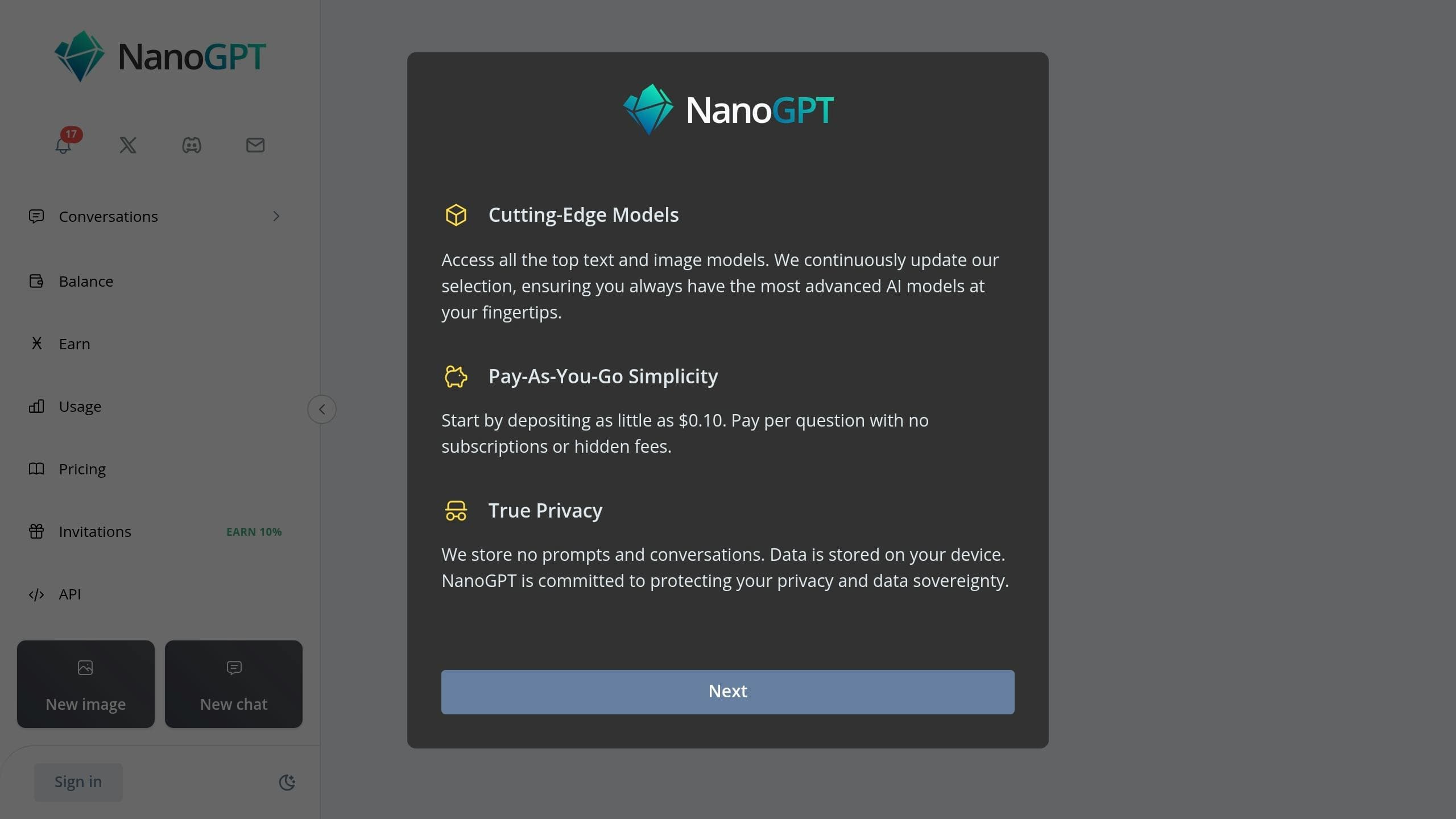
NanoGPT keeps things simple with its pay-as-you-go pricing. Users pay a minimum of $0.001 per use, gaining access to several AI models like ChatGPT, Deepseek, and Gemini, as well as tools for image generation[8]. What makes NanoGPT stand out is its focus on local data storage for privacy and transparent, usage-based billing.
| Feature | How It Works | User Advantage |
|---|---|---|
| Pay-per-use | $0.001 minimum charge | No subscription commitments |
| Model Access | Includes multiple AI engines | Freedom to choose tools |
| Data Privacy | Local data storage | Better security and control |
| Usage Tracking | Billed per question | Clear breakdown of costs |
Comparing Cloud and AI-Specific Pricing
Cloud providers and AI-focused platforms take different approaches to pricing, catering to various needs and scales.
| Provider Type | Pricing Model | Example Costs | Key Features |
|---|---|---|---|
| Cloud Providers | Resource-based | Google Cloud: $3.15 per node hour | Includes $300 free credits for 90 days |
| AI Platforms | API/Token-based | Azure OpenAI: $1.50 per 1,000 transactions | Straightforward billing |
| Hybrid Solutions | Combined metrics | Amazon SageMaker: $0.10 per hour | Offers 250 free tier hours |
For enterprises, the difference between these pricing structures becomes more noticeable. For instance, Google Cloud AI Platform offers a wide range of services but uses a complex pricing system based on factors like compute time, storage, and data transfer[7]. Meanwhile, IBM Watson Studio provides customized pricing via direct consultations, making it a better fit for businesses needing tailored solutions.
sbb-itb-903b5f2
Risks and Ethics in Usage-Based Pricing
Privacy and Price Clarity
AI pricing models based on usage need to strike a balance between tracking user activity and safeguarding data privacy. A recent study reveals that 73% of consumers are concerned about AI-related data privacy[1]. This highlights the importance of offering clear pricing while ensuring data protection.
Some companies are adopting strategies like local data storage to address these concerns. For example, NanoGPT uses local storage to minimize breach risks[8]. Here’s a breakdown of common privacy protection methods:
| Privacy Protection Method | Benefits | Challenges |
|---|---|---|
| Local Data Storage | Enhances user privacy, lowers breach risks | Requires more client-side resources |
| Data Minimization | Limits privacy exposure | May restrict pricing accuracy |
| Federated Learning | Balances privacy with insights | Technically complex to implement |
Next, let’s look at how companies are tackling unfair pricing practices.
Preventing Unfair Pricing
Ensuring fair pricing in AI services involves more than just crunching numbers. The European Union's AI Act, which will be fully enforced by 2025, demands that pricing algorithms are transparent and non-discriminatory[9].
A notable example occurred in June 2024, when IBM's Watson Pricing AI faced criticism for unintentionally charging higher rates based on zip codes. IBM quickly addressed the issue by introducing a fairness constraint algorithm, which reduced pricing disparities by 87% within three months.
To avoid similar issues, companies are adopting several strategies:
| Prevention Strategy | Implementation Method | Impact Measurement |
|---|---|---|
| Regular Audits | Conduct quarterly reviews of algorithms | Tracks bias reduction |
| Price Caps | Set maximum usage thresholds | Ensures cost predictability |
| User Controls | Allow custom usage limits | Builds user trust |
The push for more transparent pricing is gaining momentum, with fairness and privacy at the forefront. However, companies must also weigh the environmental consequences of usage-based pricing, as it can unintentionally promote excessive use of AI resources[3].
"The detailed usage data could inform more targeted AI development, potentially accelerating advancements in high-demand areas while ensuring fair pricing practices across different user segments", states a recent industry analysis[6].
Next Steps in AI Pricing
Combined Payment Models
The AI industry is moving toward hybrid pricing systems that combine subscriptions with pay-as-you-go options. Recent data shows that 78% of AI service providers plan to adopt more flexible pricing structures in the next two years[1]. This shift is driven by user demand for both cost predictability and the ability to scale expenses based on actual usage.
These hybrid models blend a fixed subscription fee with usage-based charges, offering a balance between stable costs and scalability. Analysts predict that by 2026, more than half of AI providers will adopt this approach, as it aligns with user preferences for a predictable base cost while allowing for on-demand adjustments[2].
User Privacy in Usage Tracking
As pricing systems become more sophisticated, protecting user data remains a top priority. Advanced privacy techniques, such as homomorphic encryption, federated learning, and local data processing, are helping companies track usage without compromising user trust. In fact, these measures have been shown to increase user trust by up to 40%[3].
The benefits of prioritizing privacy are clear. For example, one company reported a 25% rise in user satisfaction and a 15% increase in revenue after implementing privacy-focused practices[5]. These results highlight the dual advantages of ethical data handling and precise usage tracking.
Experts forecast that by 2027, over 60% of AI pricing models will combine at least three pricing elements, reflecting the growing complexity of AI services and the importance of robust privacy measures[4]. This trend underscores the need for pricing systems that are both transparent and protective of user data.
Conclusion
The connection between user behavior and AI pricing models continues to shift as technology advances and markets change. Research highlights clear advantages of these pricing strategies, showing how user actions directly shape pricing developments.
Privacy concerns now play a central role in influencing AI pricing structures. Using advanced privacy techniques has become crucial for earning user trust while ensuring accurate tracking of usage. These methods align well with the industry's move toward more complex hybrid pricing models.
Looking ahead, AI pricing is becoming more tailored and flexible. Some companies have seen up to an 80% drop in pricing-related workloads[1], all while achieving better accuracy and higher user satisfaction. This combination of efficiency and a focus on ethics and transparency points to a strong future for behavior-driven pricing.
As these user-focused pricing models evolve, their success will hinge on balancing user needs with business objectives. The rise of hybrid pricing systems, supported by strong privacy protections and ethical practices, sets the stage for growth that benefits both companies and users[4]. This progress is shaping a fairer and more efficient approach to AI pricing.